
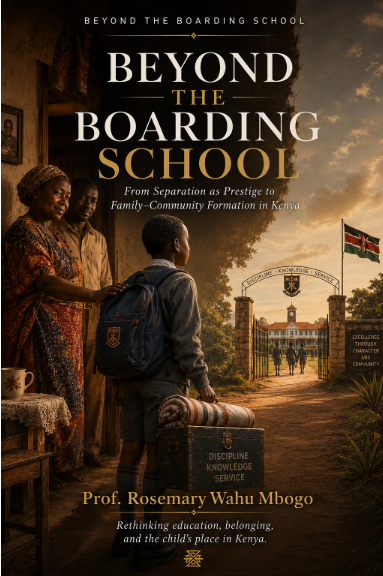
About this Book
For generations, boarding school has occupied a powerful place in Kenya’s educational imagination. It has been associated with discipline, academic excellence, opportunity, and social mobility. Yet behind this respected tradition lie difficult questions about separation from family, student wellbeing, school safety, parental responsibility, hidden costs, and the assumption that leaving home is necessary for educational success.
Beyond the Boarding School: From Separation as Prestige to Family–Community Formation in Kenya offers a timely and courageous re-examination of this model. Drawing on history, educational research, lived experience, and the realities facing Kenyan families and schools, Rosemary Wahu Mbogo asks whether boarding should remain the default aspiration for children. She explores student unrest, dormitory pressures, the role of churches and sponsors, community safety, hybrid schooling, and the need for stronger local schools.
The book does not call for the abolition of residential education. Instead, it proposes a more child-centred future: quality schools closer to home, stronger families and communities, and safe, relational, family-style residential care for children who genuinely need it. Written for parents, educators, policymakers, churches, sponsors, and school leaders, this book invites Kenya to rethink what truly enables children to flourish. It is both a challenge and a practical reform agenda.
Key Questions
Should boarding remain the default aspiration for children?
What are the hidden costs of separation from family?
How can local schools, families, churches, and communities become stronger places of formation?
When is residential care or residential education genuinely needed, and what should make it safe and relational?
Themes
boarding school; family-community formation; child wellbeing; school safety; parental responsibility; local schools; residential care
Table of Contents
Preface; The question of schooling and formation; Family, community, and institutional responsibility; Practical questions for leaders and parents; A closing call to build for the next generation.